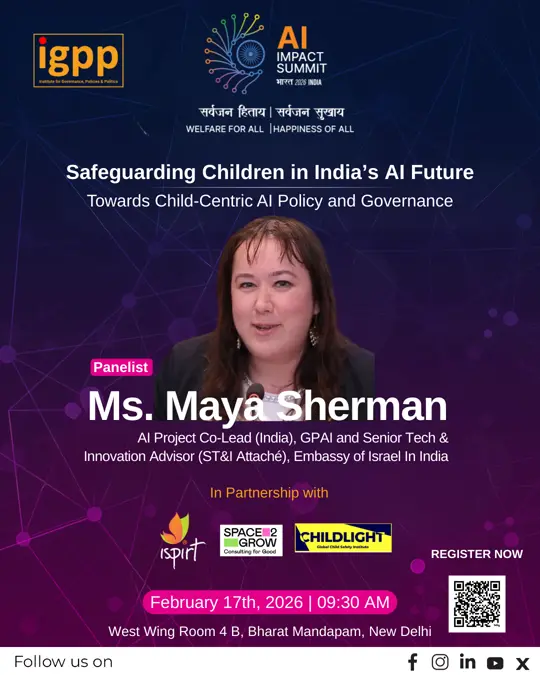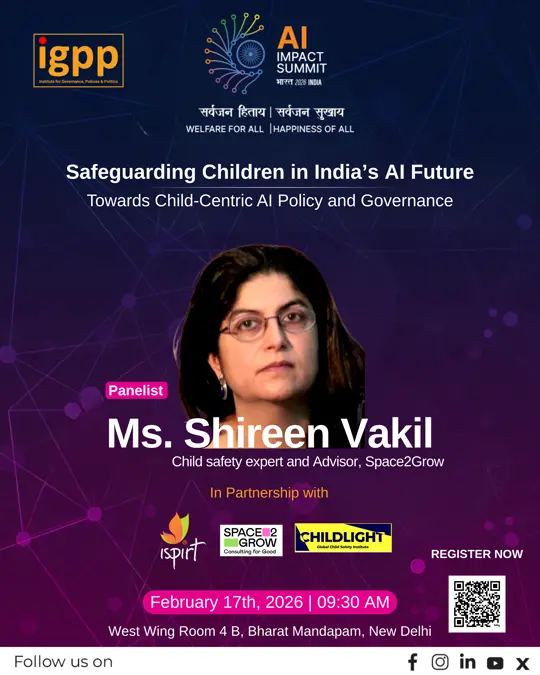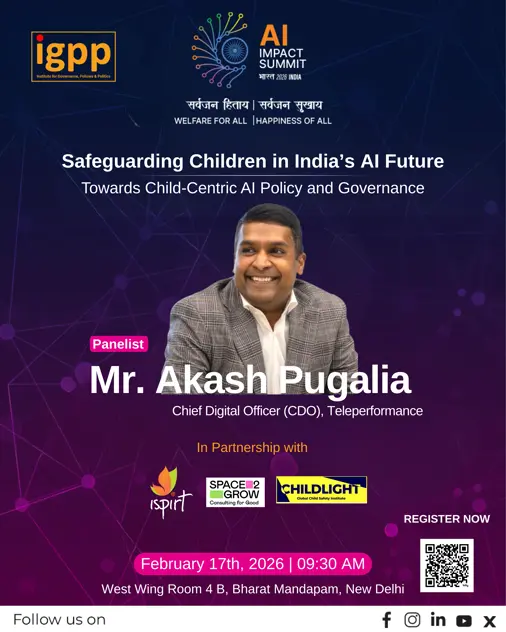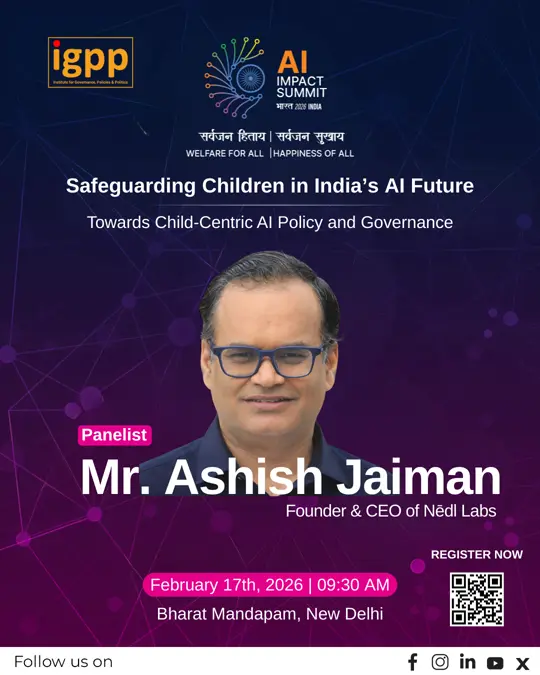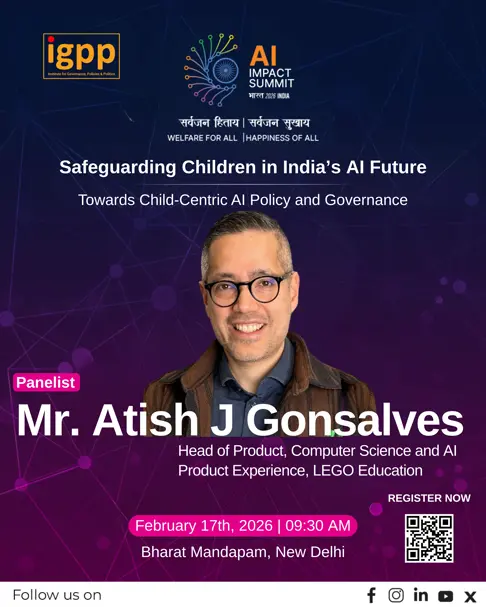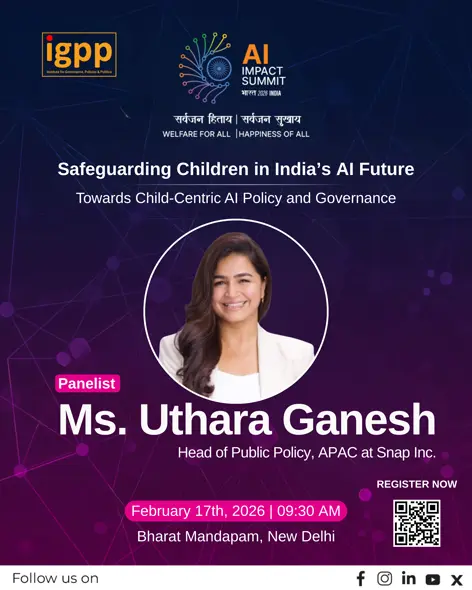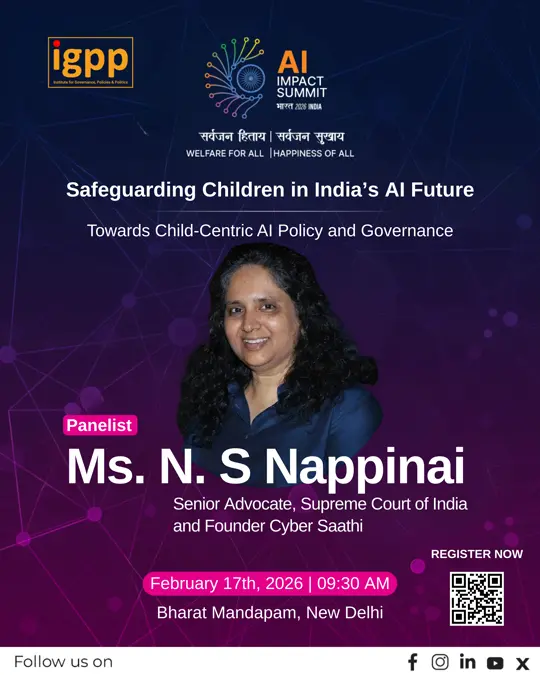

Experts









About the Event
INDIA AI IMPACT SUMMIT 2026
PANEL DISCUSSION
SAFEGUARDING CHILDREN IN INDIA’S AI FUTURE: TOWARDS CHILD-CENTRIC AI POLICY AND GOVERNANCE
Artificial Intelligence (AI) is rapidly reshaping the everyday environments in which children in India learn, play, communicate, behave and grow. From adaptive learning platforms and educational assessment tools to social media recommendation systems, gaming environments, surveillance technologies and generative AI applications, children are increasingly interacting with AI-driven systems, often without adequate safeguards, awareness, or agency.
India stands at a critical inflection point. As the country advances ambitious national AI strategies and positions, itself as a global AI leader, the governance choices made today will have long-term consequences for children’s rights, safety, dignity and development. Children are not merely ‘users’ of AI systems; they are deeply embedded within algorithmic ecosystems that mediate opportunities and risks. Despite this reality, children remain largely peripheral within AI governance frameworks. Existing policy approaches often treat child safety as a subset of content moderation or cybercrime, rather than as a systemic governance issue encompassing data protection, design choices, accountability mechanisms, and power asymmetries between platforms and young users. Thus, there is an urgent need to move beyond reactive, incident-driven responses and towards proactive, child-centric AI governance that embeds children’s rights and best interests into the design, deployment, and regulation of AI systems.This discussion seeks to formulate actionable recommendations for embedding child-centric digital regulation in India’s AI policy framework.
In this context, this session was organized by IGPP in partnership with Space2Grow and Childlight Global Child Safety Institute as pat of the IndiaAI Impact Summit 2026.
OBJECTIVES OF THE PANEL DISCUSSION
- Reframe child safety as a core AI governance concern rather than a peripheral or post-hoc issue
- Assess gaps in existing Indian legal, policy and institutional frameworks in addressing AI-related risks to children
- Explore international best practices and rights-based approaches relevant to India’s socio-technical context
- Develop actionable recommendations for embedding child-centric principles within India’s evolving AI policy and regulatory frameworks
- Foster cross-sector understanding (policy, tech, education, child welfare) on safe AI for children.
Key Themes of Discussion
Child Safety as a Foundational AI Governance Principle
Reframing child safety from a reactive or peripheral concern to a core design, deployment, and governance imperative within India’s AI ecosystem.
Legal, Policy and Institutional Gaps in Protecting Children from AI Harms
Critically assessing existing Indian legal and regulatory frameworks, institutional mandates, and enforcement capacities to identify blind spots, overlaps and gaps in addressing AI-related risks to children.
Learning from Global and Rights-Based Approaches to Child-Centric AI
Exploring international best practices, child rights-based frameworks and global governance models to understand what lessons can be meaningfully adapted to India’s socio-technical realities without importing one-size-fits-all solutions.
Embedding Child-Centric Principles in India’s AI Policy Architecture
Discussing how child-centric principles can be systematically embedded within India’s evolving AI policy and regulatory frameworks.
From Principles to Practice: Actionable Pathways for Policy and Industry
Identifying practical, implementable recommendations for policymakers, regulators, technology developers, and platforms to operationalise child-centric AI governance while enabling innovation.
Videos
Gallery