
Experts


About the Event
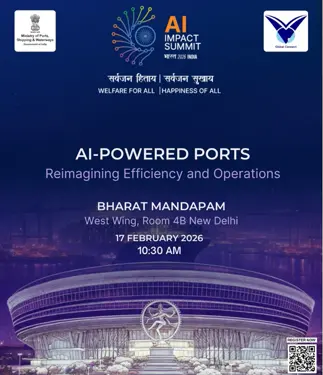
On 17 February 2026, at Bharat Mandapam, New Delhi, the V.O. Chidambaranar Port Authority (VOCPA) Tuticorin, in collaboration with the Institute for Governance, Policies and Politics (IGPP), convened a panel discussion on reimagining India’s ports in the age of Artificial Intelligence (AI). This panel discussion formed part of the high-impact deliberations at the India AI Impact Summit 2026. The session transcended beyond conversations on digitisation to examine a deeper structural question: how can AI reshape ports as strategic, intelligent national infrastructure rather than merely technologically upgraded facilities?
The session opened with a recognition that ports are no longer standalone logistics assets. In a global environment shaped by complex trade networks, climate volatility, supply-chain disruptions, and deepening digital interdependence, ports have emerged as central pillars of national economic resilience, trade security and industrial competitiveness. As the backbone of global commerce, they enable production systems, energy flows and export growth. Yet, particularly in emerging economies, structural bottlenecks persist in the form of congestion, manual documentation, unpredictable vessel turnaround times, inefficient cargo handling, fragmented data ecosystems and limited real-time operational visibility. These constraints directly affect cost efficiency, reliability, and sustainability within national and global supply chains. Amidst the existing challenges, AI presents not merely a technological upgrade but a structural opportunity.
It is in this context that VOCPA proposed a deliberate conceptual shift by shifting the discussion away from the conventional language of the ‘smart port’, which focuses primarily on sensors, dashboards, automation and digital monitoring, towards the idea of the ‘thinking port’.
The key themes during the deliberations include:
- Defining ports as intelligent national infrastructure while positioning AI as resilience and risk-management architecture rather than merely an efficiency tool;
- Addressing the human dimension of automation through skills development, institutional capacity building, and adaptive leadership;
- Strengthening policy, regulatory and security frameworks to ensure responsible AI deployment in critical maritime systems;
- Examining data interoperability, digital public infrastructure, ESG integration and the alignment of AI-enabled port governance with India’s long-term economic and strategic ambitions.