
About the Event
Artificial Intelligence is no longer a distant technological promise; it is already reshaping how we learn, think, create and make decisions. Classrooms are evolving into intelligent learning environments; assignments are being co-created with machines and educators are reimagining their roles in a world where knowledge is no longer scarce but abundant. Higher Education Institutions (HEIs) now stand at a defining crossroads and they are not just adapting to change, but actively shaping the future of human learning in an AI-driven world. This transformation, however, brings both opportunities and uncertainties. Institutions are grappling with profound questions: How does AI influence cognitive development and critical thinking among students? What does academic integrity mean in the age of generative AI? How should educators be equipped to teach in partnership with intelligent systems? How can institutions safeguard mental well-being while embracing technological advancement? What skills will define future careers and how must higher education evolve to remain relevant?
The impact of AI thus extends far beyond technology, touching pedagogy, ethics, governance, mental health and the very purpose of education itself. Higher education today finds itself in a dynamic state of transition, navigating between innovation and responsibility, disruption and opportunity.
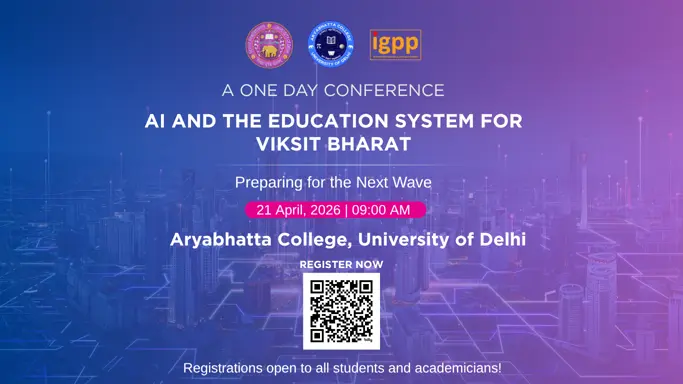
In this evolving landscape, the Institute for Governance, Policies and Politics (IGPP) in collaboration with Aryabhatta College, University of Delhi, is organising a one-day conference to bring together educators, policymakers, researchers, industry leaders and students to reflect on the future of higher education in the age of Artificial Intelligence. The conference aims to create a platform for dialogue, collaboration and collective thinking to explore how institutions can move beyond reactive adaptation and instead lead the transformation toward responsible, sustainable, inclusive and future-ready education ecosystem.
Objectives
The conference seeks to achieve the following objectives:
- To explore principles and practices that promote responsible and ethical use of AI in the education system, while preserving academic integrity, originality and critical thinking.
- To examine how overreliance on AI tools is influencing students’ cognitive skills.
- To evaluate how higher education institutions are preparing for the AI wave and how it must evolve in response to AI-enabled learning environments.
- To deliberate on the psychological implications of AI, including overdependence, academic anxiety, digital fatigue and evolving student-teacher relationships.
- To bring together policymakers, academicians, researchers, students and industry practitioners to exchange perspectives and collectively shape the future of higher education in the age of AI.
- To explore how AI is redefining career opportunities, particularly in public policy, governance, research and interdisciplinary domains and to identify the skills required for the future workforce.
- To generate practical insights and recommendations that can help higher education institutions transition toward responsible, inclusive and future-ready AI adoption.
- To incorporate student experiences and perspectives in shaping policies and practices related to AI in higher education.
Through these objectives, the conference aims not just to understand the impact of AI on higher education, but to collectively shape a thoughtful, responsible, and future-ready academic ecosystem.
Panels
Panel 1: Cognitive Impact of AI on Student Learning and Critical Thinking
Exploring how AI is transforming the foundations of teaching, learning and assessment in higher education.
Sub-themes:
- Cognitive impact of AI on student learning and critical thinking
- AI and academic integrity in higher education
- Redesigning pedagogy and assessment in AI-enabled classrooms
- Balancing human intelligence and artificial intelligence in education
Panel 2: Institutional Readiness and Governance for AI-Enabled Education System
Examining how higher education institutions can prepare for and responsibly integrate AI.
Sub-themes:
- Institutional preparedness and policy frameworks for AI adoption
- Faculty training and capacity building for AI integration
- Governance, ethics and accountability in AI-enabled institutions
- Infrastructure and digital transformation in higher education
Panel 3: Future Careers, Skills and Policy Pathways in the AI Era
Exploring how AI is reshaping career opportunities and the role of higher education in preparing future-ready graduates.
Sub-themes:
- Emerging career pathways in AI and public policy
- AI in public policy profession at different stages of policy making- policy formulation, evaluation and monitoring.
- Skills for the AI-enabled workforce
- Multi-stakeholder collaboration for future-ready education
Panel 4: Student Voices on AI and Education for Viksit Bharat
This panel brings students together to share perspectives on how AI is transforming learning, skills and opportunities. As primary stakeholders, their voices are important in shaping inclusive, future-ready education. The discussion highlights student experiences and ideas to ensure AI-driven education aligns with the vision of Viksit Bharat.
This panel discussion would be followed by a questions and answers sessions.